There are two separate jobs a crack repair might need to do, and it matters a great deal which one you are buying.
Sealing stops water. Polyurethane injection fills the void through the full thickness of the wall and cures flexible. For the ordinary shrinkage cracks in poured foundations, that is the complete and permanent answer.
Holding stops movement. It requires physical reinforcement spanning the crack, capable of carrying tension across it, so the two sides cannot pull further apart.
A moving crack that is only sealed will leak again. The resin is elastic, but it is not structural, and continued seasonal movement eventually breaks the seal or simply opens a new fracture alongside it. That is why a homeowner sometimes tells us a crack “was already fixed once.” It was sealed when it needed to be held.
Reading the crack
Most foundation cracks do not need stitching. Concrete shrinks as it cures, and a poured wall relieves that stress by cracking, usually vertically, usually near a window, a corner, or a form-tie line where the section is weakest. This happens in the majority of poured foundations and is not a defect in the house.
What warrants a closer look:
Width beyond about 6 mm. Wider cracks generally indicate genuine movement rather than curing shrinkage.
Displacement. Run a hand across the crack. If one side sits proud of the other, the wall has moved out of plane and something is driving it.
Horizontal orientation. Horizontal cracks in a foundation wall usually mean lateral soil pressure. These deserve careful attention and sometimes engineering input.
Demonstrated growth. Mark the ends of a crack with a pencil and date it. If it passes the mark within a year, it is active.
Stair-stepping through block. In concrete block foundations, cracking that steps diagonally through the mortar joints signals differential movement of the wall.
What stitching is
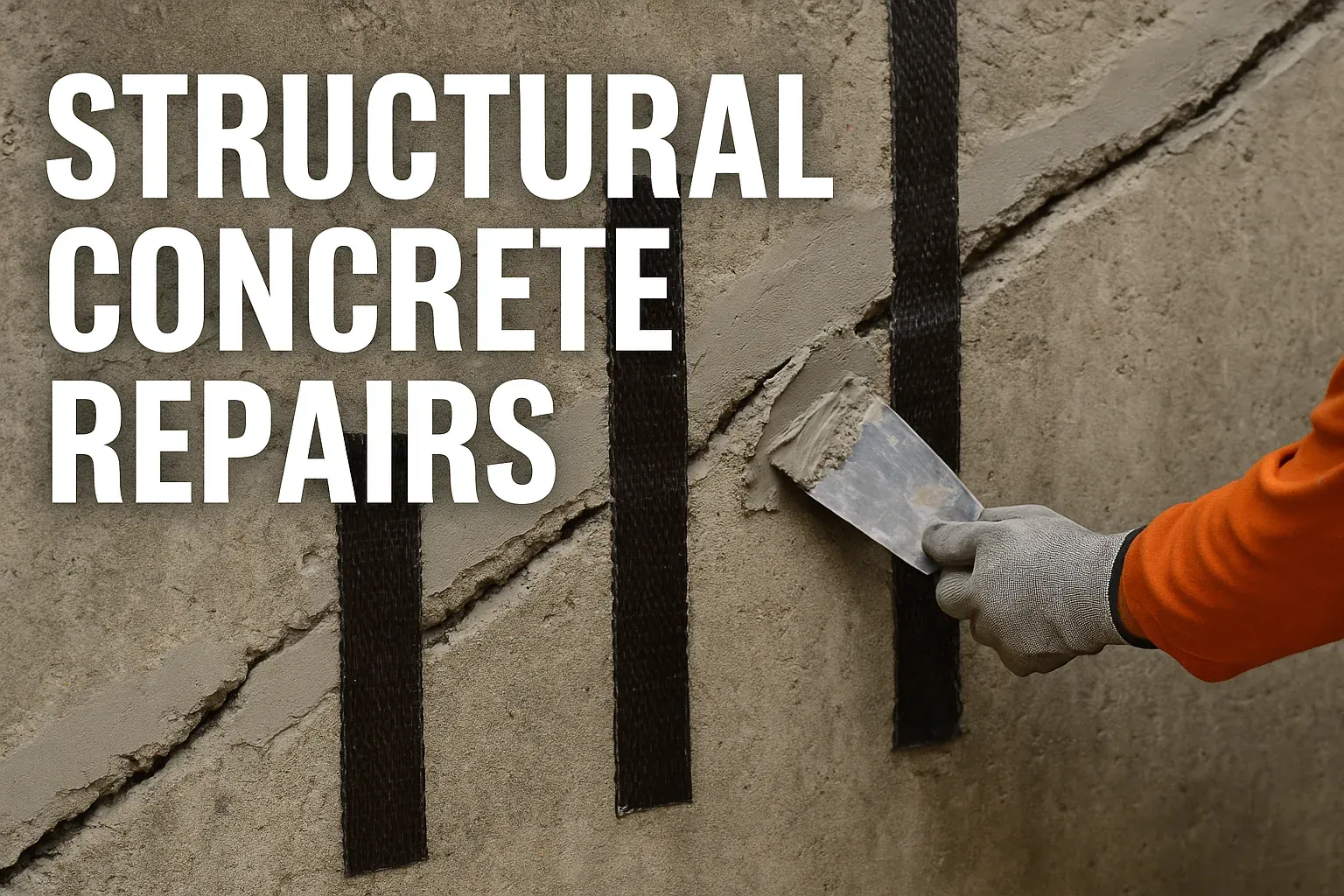
Stitching runs reinforcement perpendicular across the crack at engineered spacing, so the wall behaves as one piece again.
Steel staple stitching. Slots are cut across the crack and heavy steel staples are set into them in high-strength non-shrink grout. Each staple is a mechanical tie carrying tension across the break. It is the traditional method, well suited to wide cracks, displaced cracks, and thick walls where there is depth to key into.
Carbon fibre stitching. Carbon fibre straps are surface-bonded across the crack with structural epoxy. Carbon fibre has exceptional tensile strength for its thickness, so the repair adds almost nothing to the wall’s profile: valuable when the basement is being finished, or on a floor slab that has to stay flat.
Once movement is arrested, the crack is injected so the repair is watertight as well as structurally sound. Both jobs get done, in the right order.
Cracked slabs
Slabs crack too, usually from settlement of the fill beneath them or shrinkage across a large pour. Stitching restores load transfer across the crack so the two sides move together rather than stepping apart.
Where a void beneath the slab is the real problem, that has to be addressed first. A slab with nothing to bear on will crack again wherever you repair it.
Where stitching is not enough
We would rather turn work down than sell something that will not hold.
A bowing wall is a load problem. The soil outside is exerting more lateral pressure than the wall can carry, and it is deflecting inward. Stitching a crack in a bowing wall leaves the load exactly where it was. That situation needs the pressure relieved, usually exterior excavation and drainage, plus proper lateral reinforcement designed by an engineer.
Ongoing footing settlement is a soil problem. If the ground beneath the footing is still consolidating, any repair to the wall above cracks again in the same place. The footing has to be stabilised first.
Stone and rubble foundations move differently. They shift at the mortar joints rather than fracturing through a monolithic section, so stitching individual cracks is usually the wrong tool. Repointing, appropriate parging, and exterior drainage are what an older Nova Scotia stone foundation generally needs.
What to do next
If you have a crack you are unsure about, the useful first step costs nothing: mark both ends with a pencil, write the date beside it, and photograph it. In six months you will know whether it is moving, which is the single most important fact about any crack.
Or have us look at it. The assessment is free, and we will tell you plainly whether it is a two-hour injection or something that needs holding.
Written by the crew at Maritime Basement Waterproofing.
More advice →