Exterior Solutions
Exterior Weeping Tile
The weeping tile around your footing has a service life. On most Nova Scotia homes built before 1980, it has already ended.
Priced by linear foot and depth
What you get
- Intercepts groundwater at the footing, before it reaches the wall
- Filter-wrapped washed stone that will not silt closed
- Continuous positive slope to a real discharge point
- Installed alongside membrane and drainage board as one complete system
What weeping tile is and why yours may be finished
Weeping tile is the perforated pipe running around the outside of your footing. Its job is to collect groundwater as it descends through the soil and carry it away before it can build up against the foundation wall.
The name is a holdover. Original systems were literally short lengths of unglazed clay tile laid end to end with gaps between them, and water wept in through the gaps. Modern systems use perforated plastic pipe, but the principle has not changed.
What has changed is what surrounds the pipe, and that turns out to be the whole story.
Why old drains fail
No filter fabric. This is the primary cause. Pipe laid directly in native soil is a magnet for fine silt and clay particles, which migrate in with every rainfall and settle. Over years the pipe fills, the surrounding voids pack solid, and the drain becomes a buried line of mud.
The wrong backfill. A drain laid in native clay has essentially no void space around it to collect water from. The stone bed is not padding. It is a reservoir with roughly a third of its volume as air, and it holds and moves far more water than the pipe itself.
Roots. Perforated pipe carrying water through soil is exactly what a tree root system is searching for. Roots enter through the perforations and grow into a solid plug.
Crushing and separation. Old clay tile is brittle. Sections crack, joints separate, and the line loses continuity.
No slope, or no outlet. A drain must fall continuously toward somewhere real. Sections laid flat hold standing water. Lines that simply end in the soil have nowhere to discharge, and the trench becomes a sump against your footing.
If your home is pre-1980 and still has its original drainage, the reasonable assumption is that some combination of the above has already happened.
How we install it
The sequence is not complicated, but every step in it is a place where a system quietly fails.
The trench bottom is graded first, to a continuous fall, no flat spots, no reverse pitch. Clean washed stone is placed as the bed. The perforated pipe is laid with perforations facing down, so it starts draining at the lowest water level rather than waiting for the trench to fill. More washed stone covers it. The entire stone envelope is then wrapped in filter fabric, so water passes in freely while soil fines stay out.
The line is carried to a real discharge, to daylight where the grade allows, which is the most reliable arrangement because it has no moving parts, or to a sump where it does not.
Because reaching the footing means the wall is already fully exposed, exterior weeping tile is almost always installed as part of a complete exterior system with wall repair, membrane, and drainage board. Excavating to footing depth and putting only the pipe back is leaving most of the value in the ground.
Jobs like this
Exterior Weeping Tile in practice
Questions
About exterior weeping tile
How do I know if my weeping tile has failed?
You rarely see it directly, so it is diagnosed from symptoms. Water appearing at the floor-wall joint after rain, chronic dampness on one elevation, standing water in a window well that drains slowly or not at all, and soil that stays saturated against the foundation days after a storm all point to a footing drain that is no longer moving water. Where there is an accessible cleanout or outlet we can scope the line and confirm it directly.
How long does exterior weeping tile last?
It depends almost entirely on what it was bedded in. A drain laid in clean washed stone and wrapped in filter fabric can last fifty years or more. The clay or concrete tile used in older Nova Scotia homes, laid directly in native soil with no filter, often silts closed within twenty to thirty years, and roots find it long before that. If your house is pre-1980 and has original drainage, assume it is compromised.
Can you replace exterior weeping tile without full excavation?
No. The drain sits at the footing, which means at the bottom of the foundation. Reaching it requires excavating to that depth. Products marketed as no-dig drainage replacements do not put a drain where the footing is, and cannot do the job. If excavation is not possible on your property, the correct alternative is an interior perimeter system, which achieves a dry basement by a different route.
Should the pipe perforations face up or down?
Down. Water enters the pipe from the stone bed surrounding it, and holes facing down let the pipe start draining before the water level rises. Perforations facing up mean water has to fill the trench to pipe height before any of it gets into the line. It is a small detail that gets reversed surprisingly often.
What is the difference between weeping tile and a French drain?
Weeping tile is foundation drainage. It sits at the footing and manages groundwater against the foundation. A French drain is landscape drainage: a shallower trench placed to intercept and redirect surface and near-surface water across a yard, away from a low spot or a slope that drains toward the house. They solve different problems, and a wet basement caused by a yard that grades toward the house needs the French drain, not the weeping tile.
Further reading
More on exterior weeping tile
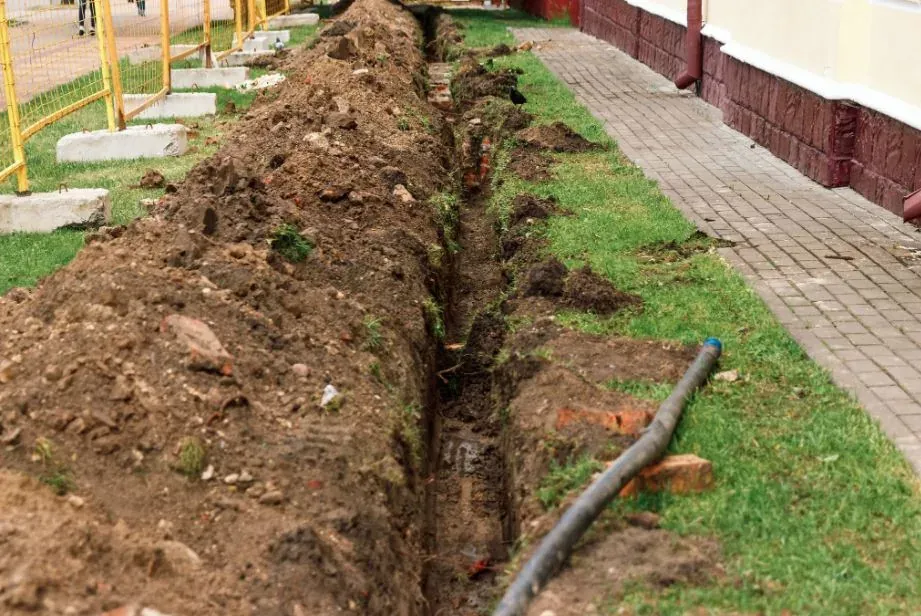
Yard Drainage Solutions for Halifax Homes
Standing water, soggy lawn, and runoff heading for the house. How to read where yard water goes, and the drainage that redirects it before it reaches concrete.
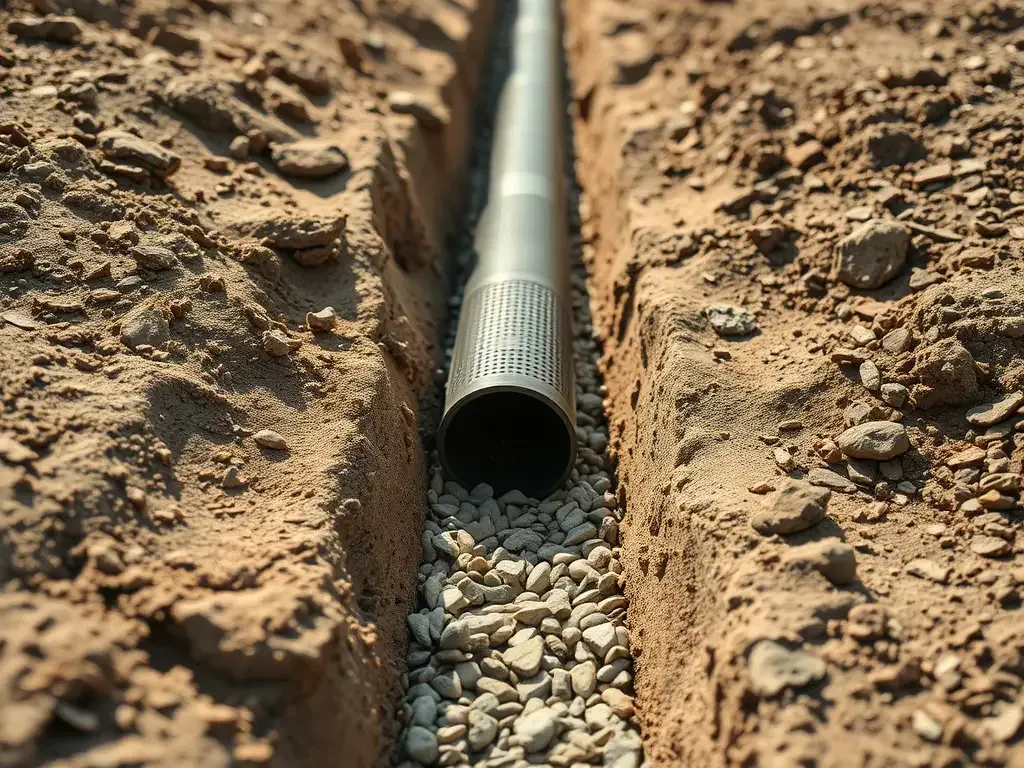
French Drains: When They're the Right Fix, and When They Aren't
French drains solve surface and near-surface water. They do nothing for a high water table under your slab. How to tell which problem you actually have.
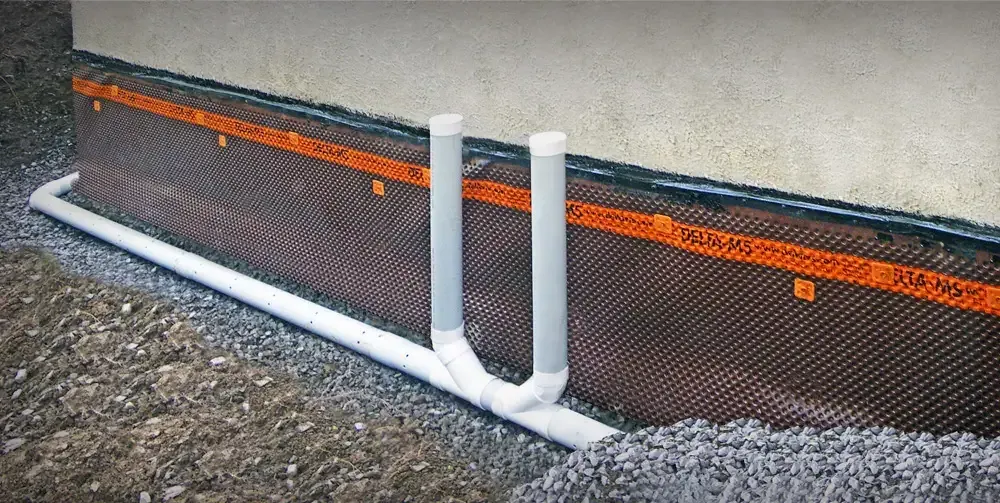
The Products That Decide Whether a System Lasts 30 Years or 5
Washed stone, filter fabric, dimple board, membrane and check valves. The unglamorous components that separate a system that lasts from one that silts closed.
Where we do this work
Exterior Weeping Tile across Nova Scotia, Cape Breton included
Free assessment
Tell us what you’re seeing.
We’ll come out, diagnose it properly, and give you a written quote. No charge, and no pressure. If a cheaper fix will solve it, that’s what we’ll tell you.
(902) 440-1500